21 July 2026 · Dean Hume
A Maturity Matrix for Game Development

A few years ago, I wrote about using a Maturity Matrix to assess software engineering teams. The idea was simple - what does a great team look like, and how honestly can you measure yourself against that picture?
Since then, I've moved into the gaming industry. Anyone who has taken the leap from traditional software development and into game development knows how different it is. Reusing the old matrix just wouldn't work.
I know what some of you are already thinking - games are creative work, not an assembly line, and a maturity matrix sounds like corporate process creeping into art. I'd have said the same thing a couple of years ago. But the crunch numbers, the missed cert dates, and the launch-week crashes tell a different story. Creativity doesn't suffer because a team has good practices. It suffers when nobody has time to be creative because they're firefighting.
So here's the matrix I actually use now - rebuilt from scratch, with the lens I wish I'd had on day one.
What is a Maturity Matrix?
If you're new to the concept - a Maturity Matrix is a list of best practices, and you rate yourself honestly against each one. I like to keep it simple with a Red / Amber / Green system:
- 🔴 Red - this doesn't exist, or we barely think about it
- 🟡 Amber - we do this sometimes, or it's a work in progress
- 🟢 Green - this is something we actively do and do well
The point isn't to feel bad about the reds. It's to give you a clear, honest picture of where to focus your energy. A lot of reds in one area? That's your priority list right there.
I've trimmed this down to the nine that matter most, in my experience - the ones that separate studios that ship well from studios that ship exhausted.
Engineering Practices
Build Pipeline Health
In web development, a slow build is annoying. In game development, a broken build can block an entire team - artists, designers, QA, and engineers all depend on it. I once watched an entire studio lose a full day because nobody could get a playable build out, three days before a milestone review. Are your builds automated and reliable? Are you catching console certification failures early, or discovering them at submission time? A healthy build pipeline is the backbone of a productive studio.
Performance Profiling Culture
Every platform has hard limits - CPU budgets, GPU budgets, memory ceilings. Does your team profile regularly, or only when something starts to hitch two weeks before launch? The best studios treat performance as a first-class feature from the start, not an afterthought you bolt on once the fun is figured out.
Crash Reporting & Telemetry
When a live game crashes, your players notice before you do. Do you have crash reporting in place? Are you tracking telemetry on key gameplay events? Can you identify a root cause quickly, or are you hunting through logs hoping for a clue while your review score drops in real time?
Oh and if you are interested, I wrote an article on the XBOX Game dev blog entitled From Crash to Resolution: A Practical Guide for Xbox & Windows Developers about this very topic.
Game Dev-Specific Practices
These don't really come up on a traditional software team, but they're make-or-break in game development.
Content Pipeline Maturity
This is the game dev equivalent of CI/CD, and it's often overlooked. How quickly can an artist iterate on a texture or a level? How long before a designer's change shows up in a playable build? Slow content pipelines kill creativity and momentum quietly - nobody files a ticket for "iteration felt sluggish," but it shows up in the work. A fast feedback loop is imperative to game dev.
Platform Compliance Readiness
Shipping on console means going through certification, and failing it costs real time and real money. Are you running compliance checks throughout development, or only at submission? The studios that handle this well treat certification like a test suite - run it early, run it often, don't let it be a surprise.
Live Operations Readiness
If you're running a live service game, this one's non-negotiable. Do you have feature flags that let you toggle things without a full patch? Can you push a hotfix quickly without breaking everything else? Do you have a rollback plan, or is "cross our fingers" the plan? Live ops is a discipline in itself, and teams that treat it as an afterthought pay for it at 2am.
Milestone Discipline
Alpha, Beta, Gold (or similar) - do these mean something concrete in your studio, or are they just dates on a calendar? A mature team has clearly defined milestone criteria. Everyone knows what "alpha" means, and everyone knows what still needs to happen before "gold." Vague milestones are how you back into crunch without ever deciding to.
People Practices
This is the category I think studios most underinvest in. Technical excellence matters - but so does the health of the people doing the work.
Sustainable Pace & Crunch Awareness
Crunch is the elephant in the room in game development. Does your team track hours? Is crunch treated as a signal that planning went wrong, or just part of the job - the cost of doing business? The studios with the best long-term output have learned to treat unsustainable pace as a problem to solve, not a badge of honour to hand out at the wrap party.
Cross-Discipline Collaboration
Games are built by engineers, artists, designers, and audio teams, often working on the same systems at the same time. How well do those handoffs work? Are your tools built with non-engineers in mind, or do they assume everyone can read a stack trace? The friction between disciplines is often where time quietly disappears.
How to Use This
Grab a notebook or a spreadsheet and rate yourself honestly against each of these. Don't try to fix everything at once - pick your top two or three reds and make a plan around those first.
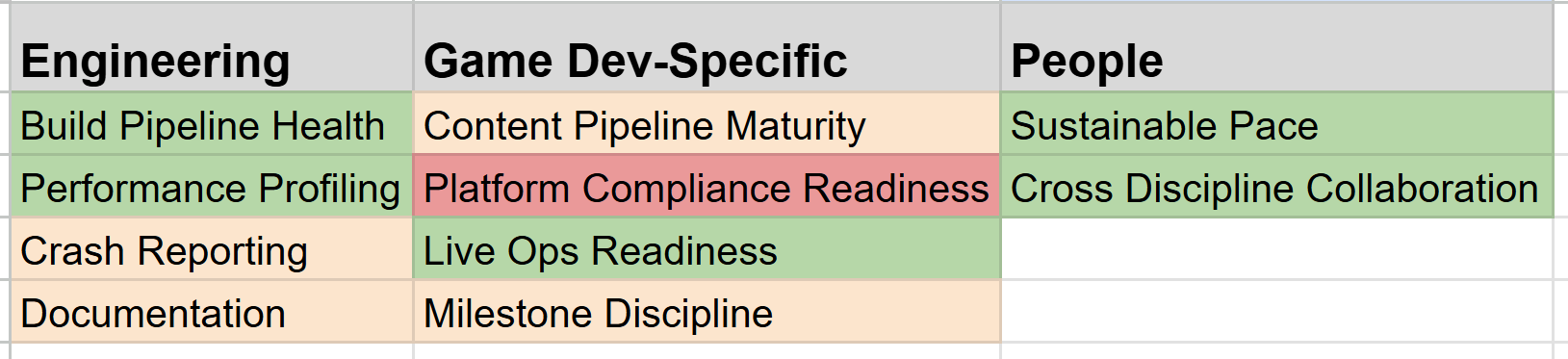
If you'd like to make a copy of this spreadsheet for yourself, please head over to this link.
The goal isn't perfection. It's awareness. You can't improve what you don't measure.
The point of this exercise is to have better data and context on how your team works, and what might be their needs. It's also worth mentioning that the list above is a light place to start, you can definitely expand and add more categories!
If you've done this kind of exercise with a software team before, some of these patterns will feel familiar. Teams get good at the things they talk about, and they neglect the things they don't. This matrix is just a way of making sure you're talking about the right things - before your players start talking about them for you. 🎮